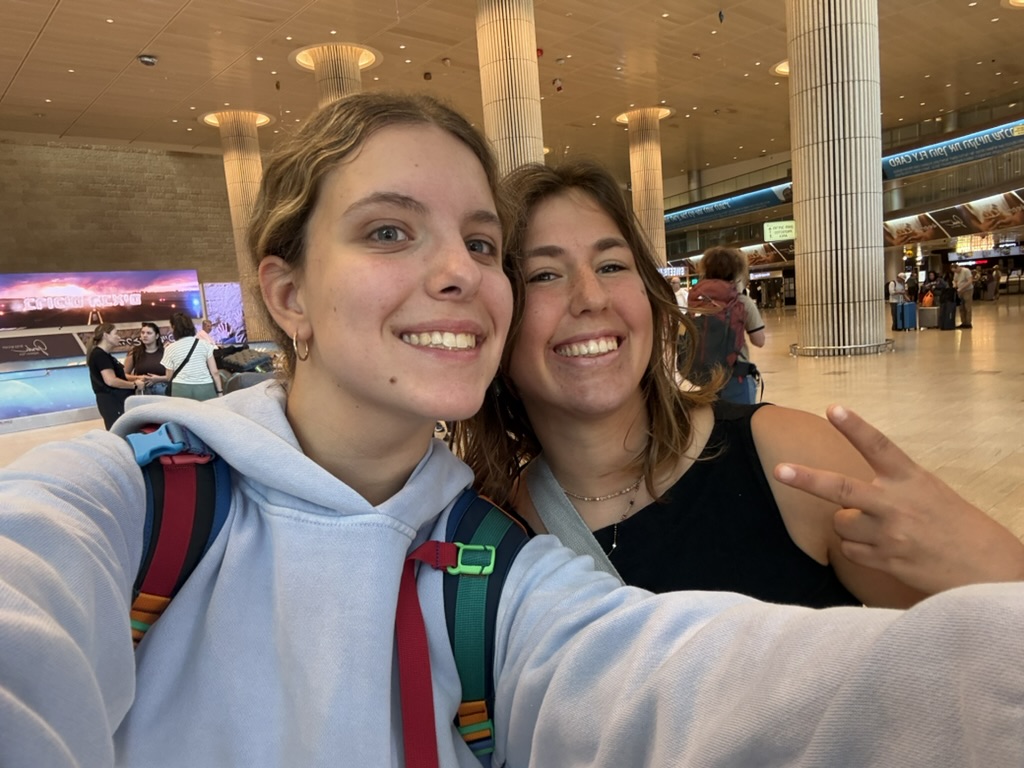

From October 24 to November 6, Mentor High School student Michelle Frumker traveled to Israel to deepen her understanding of the country and support the local community. During the summer, fellow Mentor High School student Viktoriia Pavshok traveled to her native Ukraine to reunite with her family and witness firsthand the changes taking place in her homeland. Both students voluntarily traveled to countries affected by ongoing conflict—places with deep personal significance to them—and each felt compelled to share their experiences. This is what Michelle had to share. You can also read Viktoriia’s story on Cardinal Nation.
Traveling to Israel: Michelle Frumker
I had the opportunity to learn from a local about a country I knew was profoundly different than most. Taking this chance, I was able to intertwine myself into day-to-day life, volunteer, and truly understand the heart of a new place. I understood the risks, the possible backlash I could receive, but I also understood the value of experiencing a place in your own shoes rather than through distance and assumption. Being surrounded by Judaism my whole life, I felt connected to this country through late relatives and friends who I consider family. I used to wish that to travel the world and meet so many new people, and when I met my friend Yahli, who told me I could come live with her for a short period of time, I couldn’t have been happier. As Anthony Bourdain once said “If I’m an advocate for anything, it’s to move. As far as you can, as much as you can. Across the ocean, or simply across the river. The extent to which you can walk in someone else’s shoes–or at least eat their food–is a plus for everybody.” Would I make this decision again knowing what I do now from this experience? Absolutely, with probably ten times more confidence, regardless of the country. Growth will rarely come from staying only where you are comfortable.
First Impression
After a long 12-hour flight, stepping off the plane at Ben Gurion Airport truly felt like entering a new world.
The city bustled with movement—busy yet somehow calm. Everywhere I looked, people were absorbed in daily life. As soon as I joined the flow, I felt less like a tourist and more like a participant. Border control and customs were surprisingly quick, and before long, I was reunited with my friend Yahli, whom I met at a camp I work at – she picked me up from the airport. No amount of time would ever have been enough in this country. I wandered through every street and neighborhood I could find, each one distinct yet united by a shared vibrancy. From Tel Aviv and Jerusalem to the Dead Sea, the Sea of Galilee, and my personal favorite, Mitzpe Ramon, which is a small town in the desert, and it overlooks the world’s largest erosion cirque. Every place offered something unique. Tiny shops spilled into narrow alleys, vendors shouted for attention, and families moved effortlessly through their routines. The food was vibrant and unforgettable, the architecture rooted in centuries of tradition. I tasted fresh shakshouka, which is a dish that includes eggs, peppers, tomatoes, etc, and of course, the best hummus I’ve ever had.
Life in Haifa
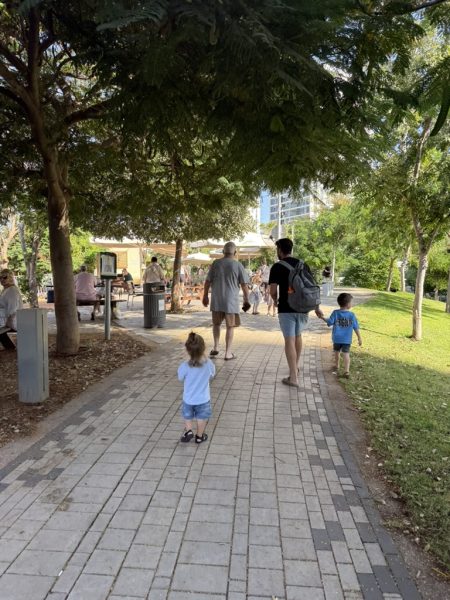
I lived in a town called Haifa. Haifa is a smaller town compared to Tel Aviv and Jerusalem, and it is located in northern Israel. The first day after arrival, I was incredibly jet-lagged. I got a smoothie with my friend, Yahli. All the fruit tasted so fresh. Afterwards, we went for a walk where I saw goats and sheep, and then in the evening, we went for a walk on this beautiful and hidden beach. The sun tends to set very early in the day, so most people do not sleep in to be able to spend most of the day with people they love and places they enjoy being. The first night, to be completely transparent, was difficult. The headlines I read before my trip were flowing in my head, and the mix of jetlag was nerve-racking for me. Getting reminders about how there were zero peaceful nights and something could happen at any second left me awake for half the night. The feeling of uncertainty was something I carried with me the first couple of nights before I was able to trust that I had nothing to worry about.
The next morning, I got coffee (which, by the way, was the best coffee I’ve ever had.) Cats are wandering everywhere, and I went into many shops where people were working on handmade art projects – between jewelry, pottery, and glass blowing. This was the moment I first realized that this country was much more than the articles I read online. The locals I met were unforgettable. Every person had a story–some joyful, some upsetting, all shaped by the land they inhabit. Every person had lost someone. Every person had been impacted. Families were central to life here, and the culture valued independence: children are raised to grow and navigate life on their own. Nearly nobody was glued to a phone. Human-to-human interaction was standard, and every single person was clearly present in their day-to-day life. It was normal to talk to strangers and discuss your plans for the day; in fact, it was courteous. I went to another beach where there was a small lagoon that I swam in and a little cliff to jump off of into the water.
Life in Tel Aviv
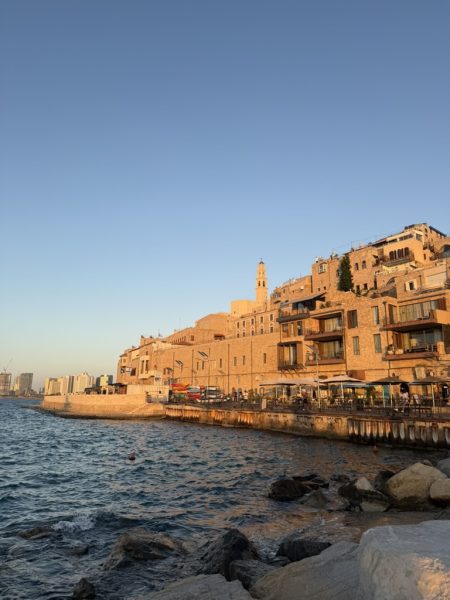
Going into Tel Aviv was absolutely breathtaking. I met many people who spoke Russian, so I was able to have a deep conversation with them. People speak Russian in Israel because lots of people immigrated to Israel from the Soviet Union, starting from the late 80s. In the late 80s, the only open immigration was to Israel, so if people wanted to go to America, they had to go through Israel, and often they would just stay in Israel. People still immigrate to Israel to this day, regardless of the circumstances. People from the former Soviet Union have large communities in Haifa and the surrounding areas, which is where I was. Since both my parents spoke Russian and Ukrainian until I was 3 years old, they only taught me Russian, and I learned English on my own.
I was so mind-boggled to hear people’s experiences and how everyone chose to come to this country, even if they weren’t born here. I always wondered why people would choose to raise their kids here, even knowing they will eventually have to send them to the army. After traveling, I understood. People were singing and playing instruments in the streets, and if they weren’t already happy, they certainly were after dancing to the music. I walked through the streets of Tel Aviv and stopped at every little shop, mostly just to interact with as many people as possible. I stayed in Tel Aviv that evening, and the city was truly alive day and night.
On a less light-hearted note, I was walking the streets with Yahli, and I heard a very loud, horn-like noise. I immediately reacted, thinking it was a siren, and noticed how other people’s heads shot up and they started moving around quickly. Others stayed seated with no reaction. Yahli quickly reassured me that it was a shofar (a musical horn), calling people to pray. It was intriguing to be able to notice who were tourists around me rather than locals, and how these types of loud noises really wouldn’t be thought of to an extent in America.
Life in Jerusalem
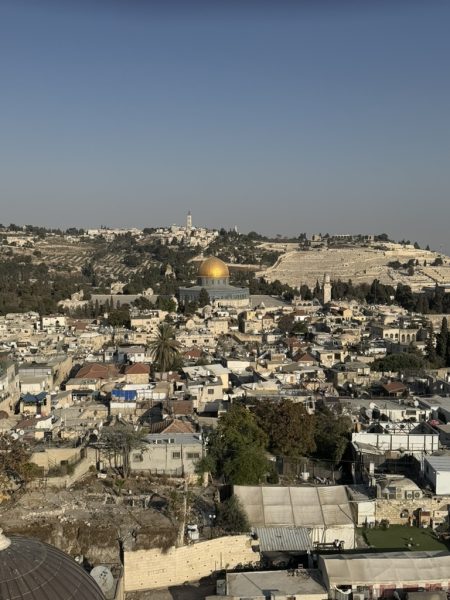
The day after exploring Tel Aviv, I took a train to Jerusalem. I made it my goal to try as much orange juice as possible in Israel, and each glass impressed me more than the last. In Jerusalem, we visited a huge market called Mahane Yehuda. There were so many vendors selling everything you could imagine. I tried some halva (a sesame-based dessert), which was amazing, and looked at different types of food within an hour. Everyone was shouting and bargaining over prices.
Later, I traveled to the Western Wall and the heart of Jerusalem. First, I went to the Church of the Holy Sepulcher and saw the tomb of Christ and the site of Jesus’s crucifixion. Then, I left a note at the Western Wall and watched how everyone respected the historic site. Individuals walk backwards away from the wall because it’s disrespectful to turn your back to the wall, as they cry from the feeling of just being there.
Masada and the Dead Sea
I ate some incredible tacos and then headed back to Tel Aviv in the evening. The next day, I drove with Yahli to Mitzpe Ramon, her favorite place—and soon to be mine. We stopped for coffee at a truck near an army base, which is common in Israel. Many soldiers were there, grabbing breakfast before heading back to training. Mitzpe Ramon sits in the desert and is a very down-to-earth place. During sunset, Yahli and I went to Makhtesh Ramon (the world’s largest erosion cirque.) It was honestly the most beautiful place I’ve ever been. Yahli spent days telling me that when you’re there, every thought just stops. She said, “The desert is just so vast that there’s no room for your thoughts to clash together.” She was completely right.
I felt nothing but pure presence at the crater. I was so moved by this feeling. I stayed in a yurt overnight, and in the morning, I hiked part of Masada National Park. They had to close the trail because of the heat, but I still managed to see Masada from above. If you don’t know the story of Masada, I recommend reading about it; it’s very intriguing, even if I had heard it a few times from guides nearby. It’s known as the Jewish revolt against Rome, where two thousand years ago, 967 men, women, and children decided to take their lives rather than conform to the enslavement by the Roman army.
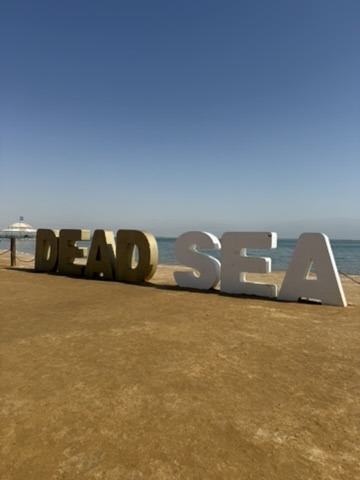
I stopped at the Dead Sea, of course. The water completely supported my body; it’s impossible not to float. Honestly, in the end, it’s not life-changing; you just feel coated in salt and grease afterward.
The People of Israel
That Friday, I visited Yahli’s family with her brother, who’s seventeen and in a pre-army training program. That’s pretty normal there—most seventeen-year-olds participate in some kind of training, and when they turn eighteen, they’re sent to a base, with occasional home visits. It was a big cultural difference, and I found it interesting to see how everyone lives and grows up. I celebrated Shabbat with her family that night. I truly loved living in Israel in a way I never expected.
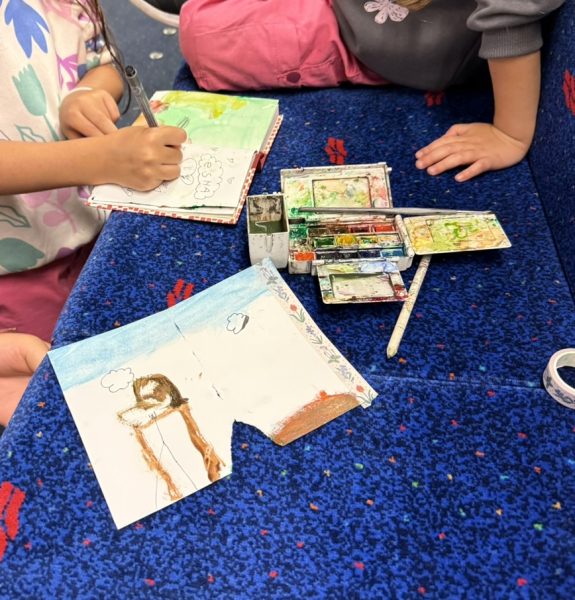
On a train back to Yahlis’ hometown, Yahli and I were quietly sitting when two young girls came over and started smiling at us. We said ‘Hi,” and they looked at each other and then at us blankly. They began speaking Arabic, so Yahli and I comprehended that we would not be able to understand them. They began doing cartwheels on the train and giggling. We communicated with them through facial expressions, noises, and hand signals. Yahli and I got up and did a handstand with both of them, which they thought was hilarious. We saw their parents sitting at the end of the train and smiling at us. Their mother spoke very broken Hebrew and English, only knowing a few words. The kids were becoming antsy, so Yahli took out her watercolor painting set and gave them a brush and some water to entertain them. The girls’ brother shyly came over and also began drawing with them. The young girls were so excited and started painting pictures for Yahli and I. After a while of communicating through smiles and laughter, one of the girls ran over to her mom and asked her in Arabic how to say “I love you,” and then came over to us to surprise us. This interaction was more eye-opening than I realized in that exact moment. Language does not require connection, and anyone can learn to connect with someone through their own unique ways–not necessarily speaking.
Fully immersing myself in the culture and daily life made my experience even richer. Saturday morning, I went on a four-hour hike that led to a spring with a dark, cold tunnel where you can swim. I met some of Yahli’s friends–one grew up in California and moved to Israel for citizenship, and another did something similar but from a different state. Hearing their perspectives, despite the similarities in their emotional intelligence, made me more curious about how this country continues to grow.
The next day, I visited the Sea of Galilee and the Jordan River–an amazing experience. Through this travel journey, signs of conflict were everywhere. The weight of it pressed down persistently: empty chairs at memorials, yellow ribbons tied to cars, soldiers patrolling the streets with big rifles, and memorials in almost every town. A sudden loud noise could make heads turn, and people tense up. Walking through the streets, I felt both awe and a little nervousness: the beauty of the culture mixed with the shadow of what this country has endured and been involved in.
The most striking thing was how safe I felt in Israel. Despite all the conflict and history, I never felt threatened walking the streets. I didn’t look over my shoulder or second-guess the people around me. No matter what the country has faced, I felt completely secure. Walking through it, I realized something simple yet profound: the world is huge, cultures are infinitely complex, and every place and person has its own story; you can only truly understand it firsthand.