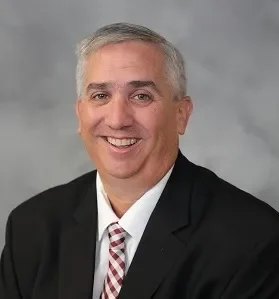


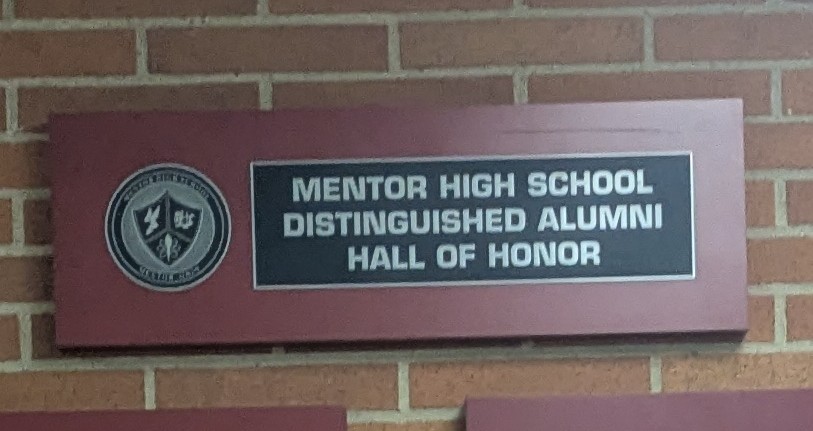
During the annual spring pep assembly, Mentor High School introduced six new alumni to be inducted into the Alumni Hall of Fame. Cardinal Nation was fortunate to interview each of them on site during a school visit about their background, expertise, and experience at MHS.
Matthew Hearn—Class of 1997
Matthew Hearn is a former Cardinal Soccer player and Class Vice President all three years of his high school career (Mentor High School in the 1990s was still a three-year building). Following graduation, Mr. Hearn moved on to Baldwin-Wallace for a degree in Business Administration and Business and Marketing Communications. Mr. Hearn is currently the Director of Sales, Industrial and Automotive at Sherwin-Williams. Mr. Hearn is the Founder and Chair of the Playing for Papa’s Annual Golf Outing to benefit the Leukemia Lymphoma Society, running for the last twelve years and counting. In 2021 he raised $60,000 for the Leukemia Lymphoma society. In 2022 he was on the Board Committee Member for the Visionary of the Year Campaign.
Cardinal Nation: What made you passionate about the Leukemia Lymphoma Society?
Mr. Hearn: So, unfortunately, my father-in-law passed away, and it’ll be ten years this May. [He was] a mentor to me and somebody that influenced my life in such a positive way, and so we as a family wanted to really build upon his legacy and made sure we created an awareness for LLS and what is now called Blood Cancer United. And, so we got involved in doing charity events. So this will be our 13th year. It’s called Playing for Papas, and it’s a charity golf event in his honor.
Cardinal Nation: What would you like to do within the Leukemia Lymphoma Society? What would you like to continue to do to ensure that it’s seen, like you said?
Mr. Hearn: Yeah, just create awareness. Whether it’s through, you know, Mentor, High Alumni Association or the Sherwin-Williams company where I work. Bringing, more people, to understand where their dollars when they donate go, charity work, and when they do donations, where it goes, and what technology and advancements and blood cancer and how it ultimately affects the lives of others.
Cardinal Nation: What lessons did you gain from MHS?
Mr. Hearn: Real relationships. Communication connectivity. I feel like in my line of work today in sales, just like bringing people together, and that’s really what I learned better. It’s such a large body of, you know, students and teachers and alumni, and ultimately, learned how to connect people, and that’s helped me throughout my career.
Julie Kandalec—Class of 1999
Ms. Kandalec graduated from MHS from Brush through the vocational program at MHS that specializes in cosmetology before moving onto local salon Jennifer and Company. In 2010 she moved to New York City leading her to appear on international runways, red carpets, celebrity events, and advertising events. Ms. Kandalec’s work can be seen on Jessica Chastain, Emily Blunt, Rachel McAdams, Viola Davis, and Rose Bryne, and others. As well as the upcoming movie ,“The Devil Wears Prada 2“. In 2020, she founded Nailpreneur to train beauty professionals. She is also co-owner of Star Touch Agency, as well as an Allure Best of Beauty judge. She has done international service in Bali, Mexico, India and via Tradeworks Foundation in Jamaica.
Cardinal Nation: How do you think the beauty industry impacts women?
Ms. Kandalec: The beauty industry impacts women and men. It really impacts everyone, Because it gives us the the freedom, the flexibility to either go in full glam, and that’s what we feel good in, or we can be like, I don’t want to wear makeup today, and I want to show my skin, I want to, you know, be myself. It gives us the flexibility to be whoever we want to be.
Cardinal Nation: Through your International volunteer work, how do you see Nailpreneur in the beauty industry provide connection between cultures and people?
Ms. Kandalec: I’ve been able to do nails…in…Bali, Jamaica, Mexico, Maldives – I’ve taught in [and] given back in India, in Jamaica. I teach, like, under-resourced youth cosmetology, [it’s] wonderful and Nails [help them]have a career … We get products for them, like nail kits, hair, and things like that, so they have their career. But then, also, we just came back for one day like to give them manicures and just make them feel really good. But then, also, when I’m traveling for fun, I’ll go and get my nails done and see what the trends are in different places…I went to Japan twice last year to see what the trends are… I went to Tokyo… so it’s kind of like beauty brings everyone together because everyone appreciates [it]. Not only their hands and their nails looking good, but … the touch, right? Because then you pass good energy around.
Cardinal Nation: What lessons did you gain from MHS?
Ms. Kandalec: I think the first thing that I’ll start with is that I almost didn’t even take the cosmetology program… There was a girl that was going to be in it. They didn’t like me. And I was like, I don’t want to do it. I’ll just do [it] when …I graduate, I’ll go to, you know, Brown [Aveda]…[But then] I was like, you know, what? I don’t care. Now, this is what I want to do…So it taught me to just focus on what I want to do, and don’t worry about other people, and guess what, we’re friends, we became friends….I still, talk to her, and so it’s like [a] big deal, and I can’t believe I almost gave [it] up.
Samantha Muzic-Weaver—Class of 2010
Ms. Muzic-Weaver attended Notre Dame College and The Ohio State University for a degree in Psychology. Following her graduation from college she coached volleyball at Olentangy Liberty High School, Notre Dame College, Eastlake North, and now MHS. She began the tradition for Shore and Memorial to play their annual game at the high school. Ms. Muzic-Weaver is a 3-time AVCA USAMC National Academic Award Winner and American Volleyball Coaches Association High School 30 under 30 National Award Winner. She is a founding member of Rock City Volleyball Club/League. She is dedicated to community service via women’s shelters, nursing homes, and End 68 Hours of Hunger.
Cardinal Nation: Do you think volleyball or sports in general have a large impact on the success of students at a young age?
Ms. Muzic -Weaver: Absolutely. I think it sets them up for success because you’re getting a routine. You’re getting failure. You’re getting all of those things in one kind of bundle. And so, it definitely sets them up for success because [you] gotta learn routines.
Cardinal Nation: What lessons did athletics teach you?
Ms. Muzic-Weaver: To stay with it and to keep fighting and to always push forward because you fail all the time in sports at every time, every time you do anything... And so, you just gotta get back up and keep going. And that’s something that athletics taught me.
Cardinal Nation: What lessons did you gain from MHS?
Ms. Muzic-Weaver: I learned the relationship piece. I learned how to make those connections with people, whether it’s teachers or players or friends of all different [places]. It really taught me to have those relationship pieces.
Gerald Preston Scott, Jr.—Class of 1970
Dr. Scott attended Ohio State University for a degree in Zoology, going on to earn his PHD in Biological Oceanography from the University of Rhode Island. He did research to support domestic and international Atlantic fisheries. He was elected chair of the International Commission for the Conservation of Atlantic Tunas (ICCAT) committee in Research and Statistics, and he was also the chief U.S. scientist to ICCAT. He worked with the non-government organization International Seafood Sustainability Foundation (ISSF). Through the ISSF he has published several articles, videos, and scientific reports.
Cardinal Nation: How would you like to see over fishing be solved sustainably?
Dr. Scott: Well. I think to a large degree over fishing is getting to be a thing of the past. There are mechanisms now in place that allow decision makers to take informed decisions to limit the amount of harvest that’s done. Of course, there are some issues that will be difficult to overcome, such as the effects of climate change and the populations that we relate to. And that’s still a developing science because it’s hard to predict what will happen into the future under certain conditions.
Cardinal Nation: Do you think aquaculture poses a threat to natural populations in the food market?
Dr. Scott: I don’t really think aquaculture poses a threat, although there are concerns, especially if there are disease organisms that persist in the cultured species that escape into the wild. That’s not typically an issue with the types of fish I’ve been involved with. There are large oceanic species like tunas. But there are aquaculture efforts underway for two [areas], especially in the Mediterranean and the Japanese Waters, and some of those fish make it to market, so it’s a positive thing. It takes away some of the pressure, [on] wild populations.
Cardinal Nation: What lessons did you gain from MHS?
Dr. Scott: Well, I think I gained a pretty strong foundation for my career work, of course. Mentor was part of my educational process. It did give me a strong basis for furthering myself in school, and in my profession.
Mark Proegler—Class of 1974
Mr. Proegler earned his Bachelor of Science in Chemical Engineering at Purdue University, and his MBS at Kellstadt Graduate School of Business at Depaul University. He is an expert in energy and climate, working in the U.S., Europe and Australia. He managed and chaired a multi business European Task force for participation in E.U. emissions. He has been a part of several non-profits including Flossmoor Community Church, Habitat for Humanity, Financial Mentors of America (a non-profit focusing on financial literacy), Sleep in Heavenly Peace (providing beds to children in need), and at Houston Technology Center as a business advisor to new businesses.
Cardinal Nation: In the near future, we’re seeing that fossil fuels are becoming increasingly scarce. What form of renewable energy do you think we should move to?
Mr. Proegler: So, first of all, fossil fuels are going to be needed forever. They’re [the] cheapest the most dense form of energy, so I think it’s a combination of fossil fuels and renewables. So I think great strides are being made. And you know, wind and solar, the key with that is both storage…So those are the issues with [fossil fuels].
Cardinal Nation: How can companies and people reduce their carbon footprint?
Mr. Poegler: I think the best thing is to be more efficient and mindful of what you’re doing. But recognize it’s not the only thing I think. Environmental issues are still important, but poverty is actually the bigger one. So do what you can to help with [emissions], too.
Cardinal Nation: What lessons did you gain from MHS?
Mr. Poegler: It was really a reflection on the impact that my teachers made on me, but also the experiences of being in all the clubs really provided opportunities to meet with people, teamwork, and things like that. So, I’m just amazed and impressed by the school.
John S Everett Sr.—Class of 1980
Mr. Everett opened his own business after graduation, Auto Experts, before moving on to Facilities Manager for Libra Industries and is now Maintenance at Princeton Tools. He is committed to helping our Nation’s Veterans, founding his own non-profit, Helping Vets with our Collared Pets, helping to train companion animals for veterans. He is also involved with the Wounded Warriors project raising over $250,000, and was awarded the Decorated Patron Award by the CEO of WWIA of the Wounded Warriors project.
Cardinal Nation: How would you like to see veterans be supported in the future?
Mr. Everett: [The] foundation that I support the Vets with, so everybody can help vets. That would be great. Like I said, I have my own Foundation. I have charity Raffles to raise money to give to the Vets to help them out that way.
Cardinal Nation: What is the most inspirational moment from either your charity or when you worked with Wounded Warriors?
Mr. Everett: It’s probably when I started my own Foundation. Working with the vets, getting the foundation talking to people, explaining to them what I do and what the vets are. It’s amazing.
Cardinal Nation: What lessons did you gain from MHS?
Mr. Everett: Pretty much the way of life, you know, the way of life. How to respect people.