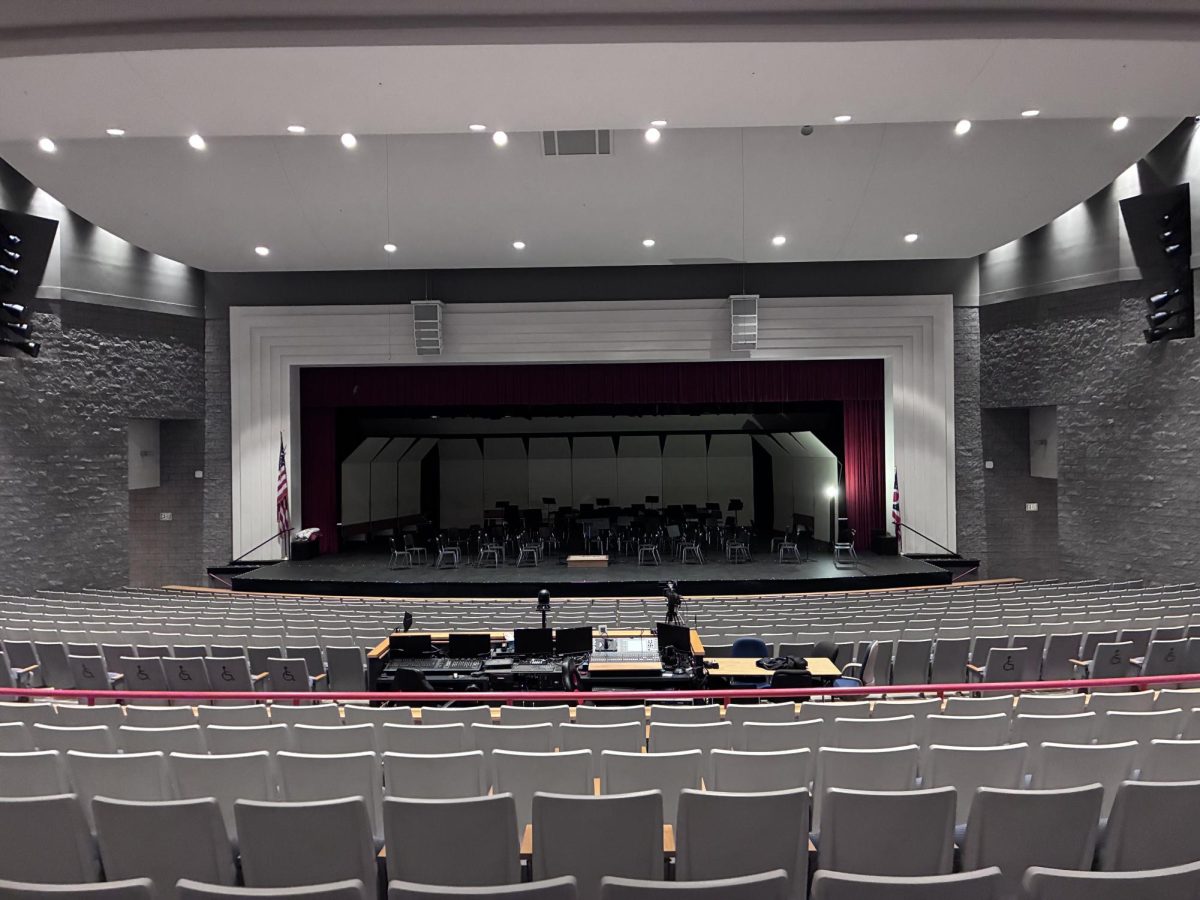


All the world’s a stage, and all the men and women merely players.
This phrase from a play by William Shakespeare has passed through the centuries, and its relevance today is undeniable. Our life is like a theater, and as we live it from birth to death, we act in different ways, take on different roles, and find ourselves in different situations, events, and problems. We live according to a script that we write for ourselves.
At different ages, life is experienced differently: different understanding, different behavior, different approaches to situations.
Recently, in our English class, our teacher Mr. Christopher Sauer had us reading Shakespeare’s play “Hamlet.” I can’t say it is an easy work to understand, and it is certain that at different ages it will be understood in different ways.
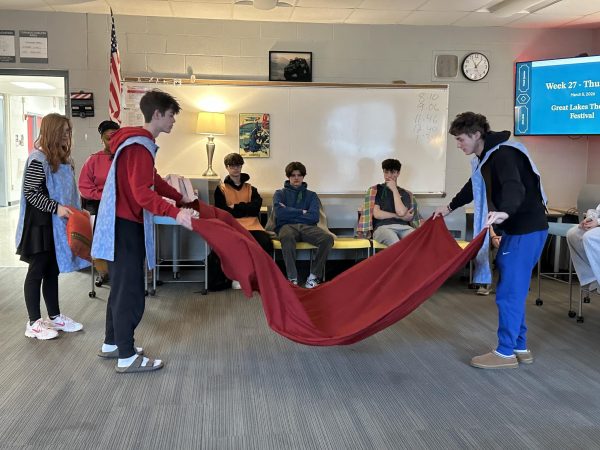
To better understand Shakespeare’s language, actors were invited to our school. The actors who visited our school were from Great Lakes Theater in Cleveland. It’s a professional theater company that focuses on performing classic plays, especially Shakespeare. They also work with schools, helping students better understand his language and ideas by actually seeing the plays performed. Their goal isn’t just to act, but to make the experience more interactive and easier to connect to for students.
“Theater has been a part of the human experience for thousands of years,” says Mr. Sauer. “Working with the actors gives students a chance to experience theater as a performer instead of an audience member or reader. The tradition of hosting actors from Great Lakes Theater Festival started long before I became a teacher, so I’m also helping to preserve a tradition that is often a student’s favorite memory of 12th grade English.”
He also explained how this approach supports students’ understanding of Shakespeare.
“This experience helps our understanding of Shakespeare because the actors are content experts who ensure students understand their lines and the historical context surrounding their roles,” says Mr. Sauer. “The actors also lead vibrant discussions that help make modern connections to texts that are hundreds of years old.”
According to him, this has been a long-standing part of the school’s program.
“I’ve hosted actors for each of my 17 years as a teacher at MHS; however, they have been coming here for over 30 years,” says Mr. Sauer.
Students, however, initially expected a simple theatrical performance—a role-play following a script. This was clear from their answers to the question: “What were your expectations before the actors came? Now that we are in the middle of the experience, what do you think of it?” These are some of their responses:
- “I was expecting them to like perform the entire play for the class throughout the week. Now that it’s the middle of the experience I think that they are really professional and good actors.”
- “I honestly thought there would be a big group of them acting everything out and we watch. It was the opposite—we as students in the class are able to get involved.”
- “Before they came in I didn’t expect it to be anything special or engaging, but after seeing them act I now know I was wrong. It is very cool seeing them act out the play with their emotions and action fully engaged. They are very good at grabbing the audience’s attention and keeping things fun and interesting.”
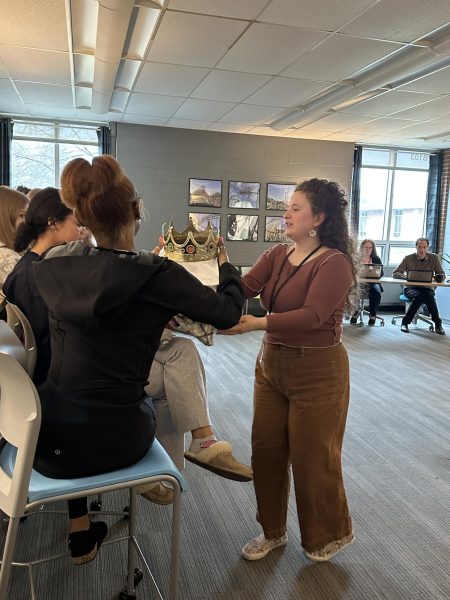
Students indeed became part of the performance—they were participants, not just spectators. They stepped into another world, another era – into Hamlet’s family. It was unexpected. This resulted in new feelings, new perspectives:
- “After the actors came in it’s made me realize that acting is truly art. I always thought of it as memorizing lines and just putting on costumes, but seeing the actors gave me a much deeper realization that what they’re doing is art.”
- “It’s nice to literally see it differently in the sense that reading something that is meant to be performed versus actually watching it performed makes things make more sense.”
- “I used to think Shakespeare and theatre were kind of boring and hard to understand. Now I see that when it’s acted out, it’s way more interesting and easier to connect to. It feels more real and emotional than just reading it.”
Short video
As mentioned earlier, understanding Shakespeare’s language is difficult, but when you personally experience different situations from the play together with professional actors, it gives you a deeper understanding of what was happening at that time. After that, a desire appears to explore other works by Shakespeare. Is this really so?
Students were asked: “Now that you have learned about Shakespeare, what is the likelihood that you might try to explore him more in films, plays, or other venues?”
- “Now that I’ve learned more about him, I’m more likely to explore his work in movies or plays. I didn’t think I would before, but now I’m more open to it.”
- “I feel like learning about Shakespeare has sparked my interest in learning about our past and the thoughts people had on certain opinions and topics such as theology that played such crucial roles in the way they perceived life.”
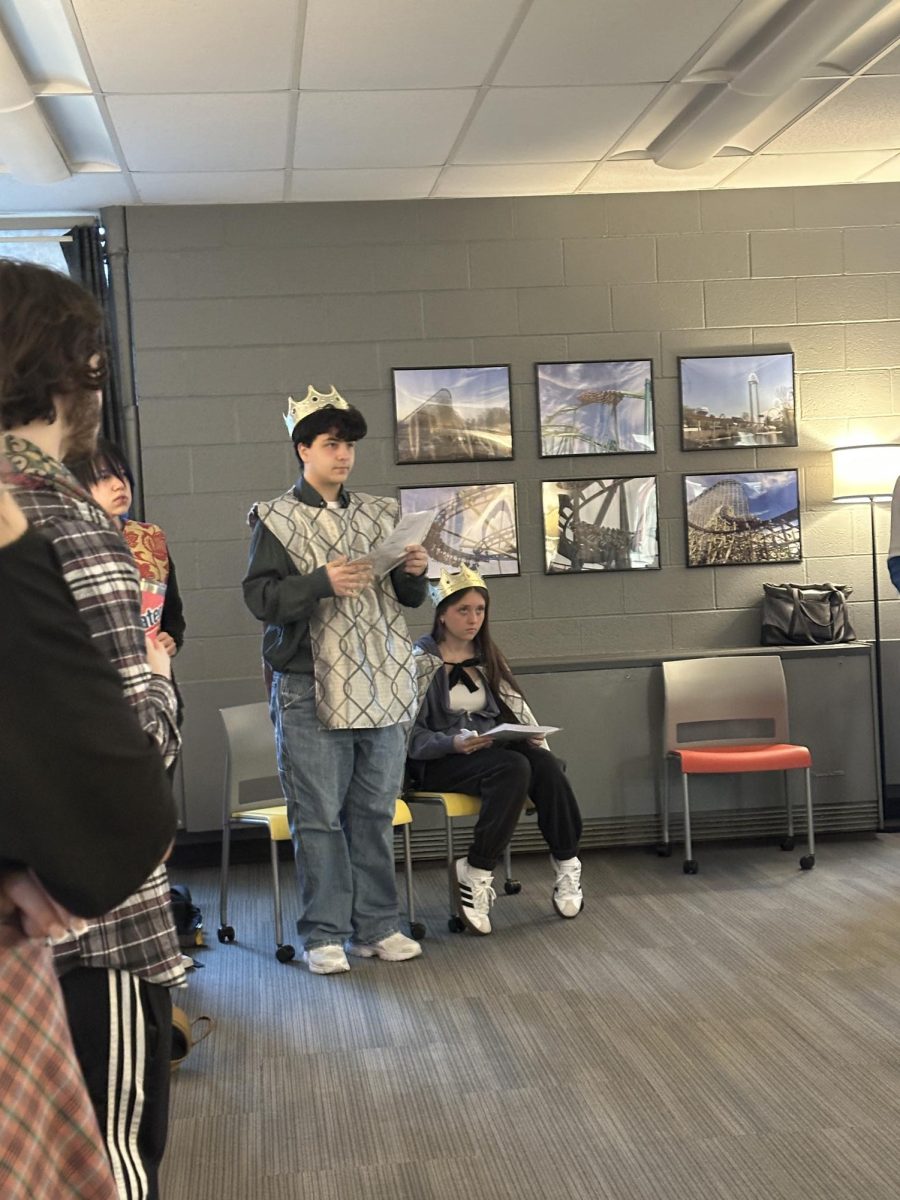
Understanding and perception always comes through feeling. We live our lives guided by both reason and emotion. In his works, Shakespeare wrote about things that exist beyond time. He gave his characters life, events, and feelings that we still experience today: despair, joy, anger, jealousy, hatred, and revenge. All of this is inherent to every person in any period of time. That is why we still talk about Shakespeare today—and students confirmed this:
- “In my opinion, Shakespeare’s works are important because they show readers the complexity of human psychology. Furthermore, the characters he creates are very realistic, flawed, and emotionally multifaceted, allowing each generation to reinterpret them, for example, in his work ‘Hamlet.’ In addition, his works have been adapted into films and plays, proving that his ideas transcend time and culture.”
- “I think a lot of Shakespeare’s material holds up over time because the topics he wrote about and the emotions he gave his characters still exist today, and people still resonate with them.”
We can see that today, in terms of our actions and their consequences, is sometimes like a reflection of the events in “Hamlet.” Sometimes we do not think about the consequences, we act spontaneously based on emotions, and we silence the voice of reason. But as the saying goes, “If you seek revenge, dig two graves.” Shakespeare gave us this lesson, and students understand it:
- “I definitely think Shakespeare still has lessons for us today. Even though he lived over 400 years ago, he wrote about topics that are still really relevant in our everyday lives, like love, jealousy, ambition, betrayal, power, and figuring out who you are.”
- “I think yes, Shakespeare still has valuable lessons for us today. His plays teach us about the dangers of ambition, jealousy, and revenge…Even after 400 years, people still struggle with power, love, and identity. And even now, although the world and people have made tremendous strides in technology and scholarship, their character remains unchanged.”
All the students experienced something new, gained new knowledge, and received lessons for life and about life. Shakespeare became a teacher, and the invited actors helped us understand and realize these lessons.
Long Video
Perhaps, if Shakespeare could see the future, he would say: “Everything is as always—nothing changes…” I think he would be right: time passes, places change, but human nature remains the same.