


Lay Your Head to the Comfort of the Rain
I like to sit in the center of a storm’s unrest
Where pines engage in savage banter, silver wit, against the blossoms,
And the shadows offer what the light has from me suppressed –
A solace the world has since bid me to quit – my stolen joyous freedoms.
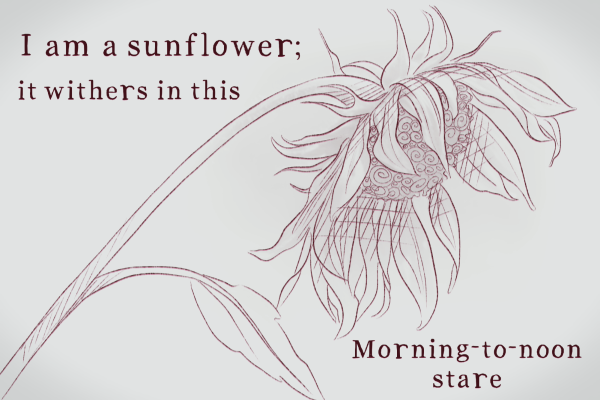
I am a sunflower; it withers in this morning-to-noon stare.
The sun’s hot fist stays still over Gibeon, a heavy, gold demand.
A fourth day fixture, it’s late but lay claim to all air, leaving this dry and breathless glare –
An endless desert and hollow land.
Under that gaze my spirit learns kinship with scabs and ash.
Those watchful eyes drink the peace and memory of dew.
But on days like this the thunder breaks habit – a sudden crash –
It paints your world in gray but mine in glorious blue.
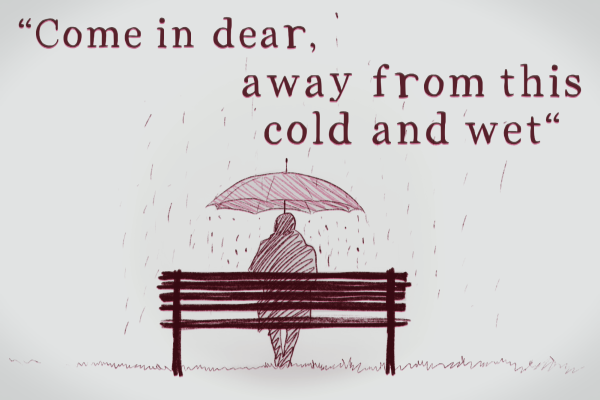
“Come in, dear,” they cry, “away from this cold and wet.”
Fearful for the clouds, a widow’s veil over the sky
They forget what I cannot forget:
Only in the floods am I dry.
One more minute. Let every droplet trace parched lines of heartache on my skin;
I shall take drenching over gluttonous golden grace and find joy where danger ushered
itself in.
Synopsis of my favorite parts of the poem (from the author):
- In this poem I wanted to challenge that very typical notion of poetry that the light or the sun is always a comfort. There’s the cliché idea that light draws us in or that by bathing in it, we are reborn—rejuvenated, so to say. So, the idea of peace in a thunderstorm comes from this idea of finding peace in things that maybe shouldn’t be? Having grown up in less than fortunate circumstances, I find I still look upon those times more fondly than now. There is some comfort that was brought in the harshness—perhaps the closeness of friend and familial bonds – that makes the storm to me more appealing than the sun. Now in this challenging notion, of course, not only does the storm take on a different perspective, but so too does the sun/light. In this case, the sun represents this feeling of living in an eternal spotlight — it’s hot and draining. I took what is typically a symbol of beauty and life and related it more to how the sun causes burns. It essentially speaks to how when you’re not struggling it feels like there is perhaps a pressure to do well and forget the past (the storm). Almost as if idealism (the sun) doesn’t want to allow you to see hardship (the storm) in a positive or nostalgic way. I think this theme is relatable in many ways to H.S. students, as we can sometimes feel the pressure when we do well to not want to long for when it was easier, even if that meant you weren’t as smart or successful as you are now.
- The sunflower as a metaphor; it stands to represent how something has fallen against a natural order. A sunflower of all plants, rejecting sunlight, unable to bear it. Suggesting the sun has become too much in its unwillingness to move and let the rain or shadows in. I wanted to provide this image that the sun has long overstayed its welcome, and so we have this flower that withers from the dehydration of the absence of rain. Again speaking to this idea of some of the harsh pressure that comes with the “ideal” life.
- The two biblical allusions; the first is the allusion to Gibeon, which, in the Bible, is a story that says for ten days God held the sun over Gibeon and the moon over the Valley of Aijalon, which was said to give enough time for the Israelites to finish their war. I liked this allusion, one, because I felt like it showed the two perspectives on light. On the one hand, for some it will be strength and for others it will be loss — suggesting some will flourish in the ideal while some cannot. But I also felt like it suggested the speaker needed the moon to come. They are waiting for God to let the sun go on its way so they can get back from the shadows what the sun was previously explained to have suppressed from them. The second allusion is when the sun is referred to as a “fourth day fixture”, which refers to in the bible that God made the light on the fourth day. I included this allusion to emphasize the idea that, from the speaker’s perspective, there didn’t used to be a sun, it showed up late and that is part of the struggle — the speaker doesn’t know how to adjust to the light. So, in this way, the speaker sees the light as all-encompassing to them, it is self-absorbed with little consideration for what life was like before, though it’s explained later to enjoy what before had to bring as it “drinks the memory of dew.”
- What does this line mean? “Those watchful eyes drink the peace and memory of dew.” This line suggests that all that is ideal must come from hardship, you can’t get to an ideal life without enduring some difficulty. In this line, though, the speaker sees this fact as an insult, as the ideal can have the memory of the past, but the speaker feels like they cannot. I wanted to express the feeling that sometimes we feel like we have to move on from the past—forgive and forget if you will — but that can be a painful process, maybe not even a necessary one.
- Irony, “Only in the floods am I dry.” This line is rather simple, but I like the irony it provides: the speaker is only dry (meaning stable/peaceful) in the flood.
- The end resolve: At the end of the poem, the speaker waits in the rain for another minute and in this line I had bounced between the idea of having the speaker become the sunflower again. However, I like the resolution that it brought by allowing the speaker to part ways with the metaphor. I thought it suggested the speaker is so comforted by the rain they don’t need that shield from reality that the metaphor is meant to provide.
- Alliteration in the last line: In the last line I wanted to have a linguistic contrast between the sun and the storm. The storm, in a connotational sense, is much more threatening but the words “danger ushered itself in” don’t really have any trouble rolling off the tongue. Whereas, gluttonous golden grace is difficult to say because, while the alliteration makes the words very similar, gluttonous is relaxed, while the long “o” sound of golden now forces a drawn out sound that’s not relaxed. Your face must make that “o” shape. Additionally, while the first two words are nasally, grace has a soft “s” sound, all of which create just enough distinction that the words are literally uncomfortable to say. The words all have a punchy beginning which doesn’t provide your brain much time to process the difference, so it puts the reader in the shoes of the speaker right at the end.


